Quick summary
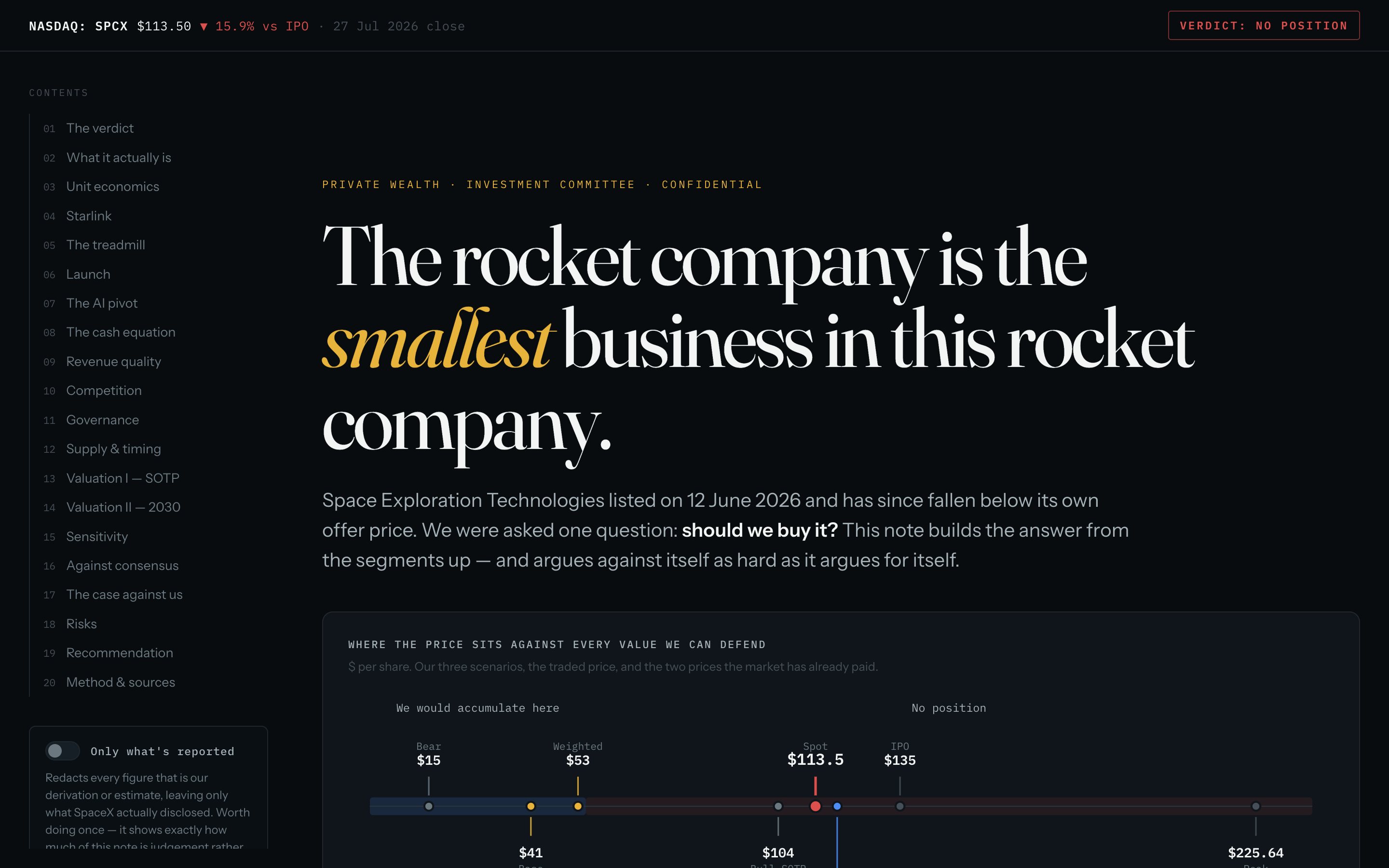
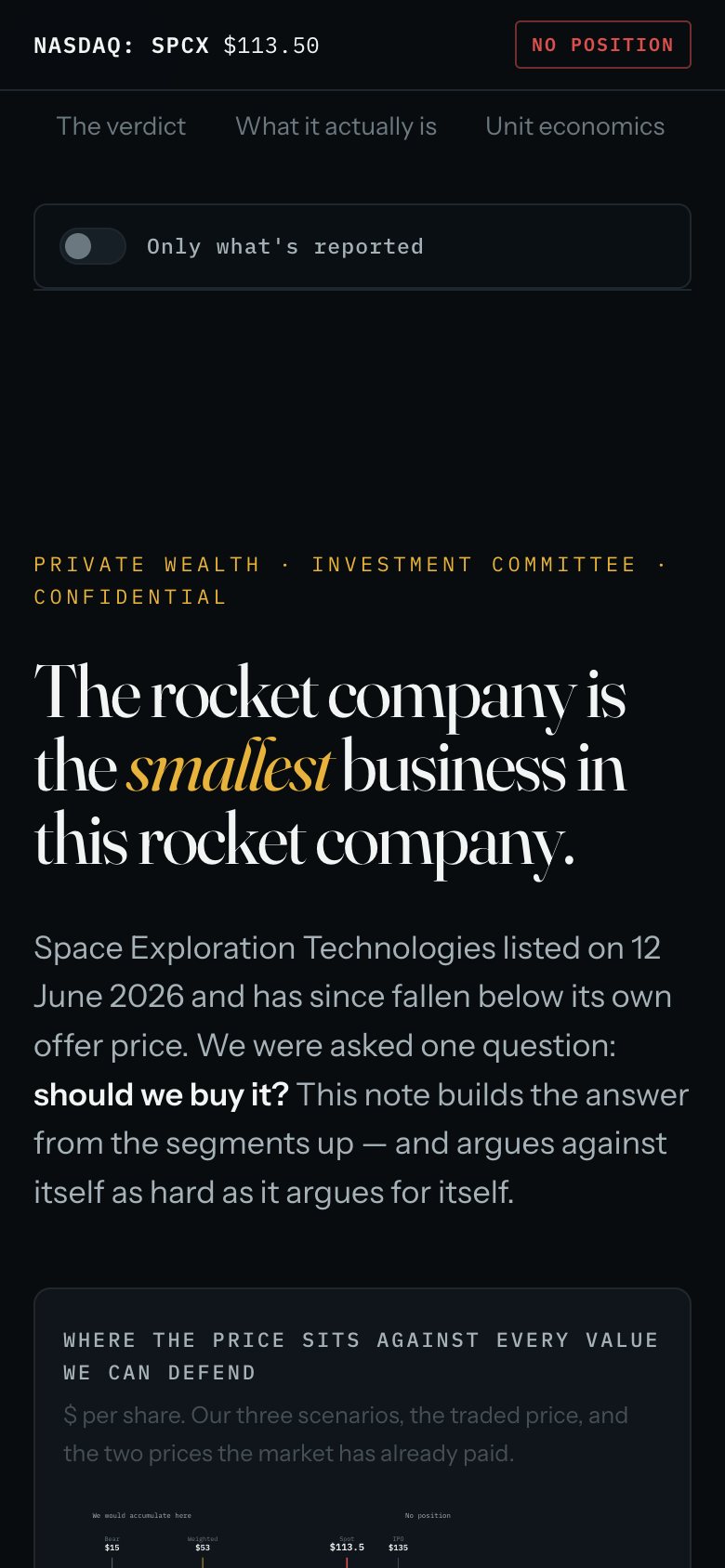
Most research pages are a PDF poured into HTML: a wall of prose, a few flat images, and a conclusion you have to take on faith. This one is built the other way round. It opens with the verdict, then spends twenty numbered sections earning it: segment economics, unit costs, capital allocation, competitive position, governance, valuation on two independent methods, and a section whose whole job is to make the strongest possible case against the conclusion. Every chart is drawn from a model that ships with the page, so the numbers reconcile rather than merely illustrate.
Who this template is for
A case built to survive scrutiny. It’s for analysis where the reader is expected to push back.
- Funds and analysts publishing investment memos that have to withstand committee scrutiny
- Consultancies and research teams presenting findings that need to be auditable as well as persuasive
- Data journalists and market analysts who need on-brand charts instead of someone else’s defaults
What problem this template solves
Long-form research usually ships as a PDF that nobody reads past page two. This build treats the document itself as a designed product.
- PDFs bury structure, so readers can’t feel how far along they are or jump to what matters
- Data tables exported from spreadsheets arrive unstyled and unreadable on small screens
- Analysts have few references for publishing serious work on the open web without a platform
What you get with this template
You get a twenty-section investment committee note that opens with the verdict and spends the rest of the document earning it. A full section is there only to argue the other side.
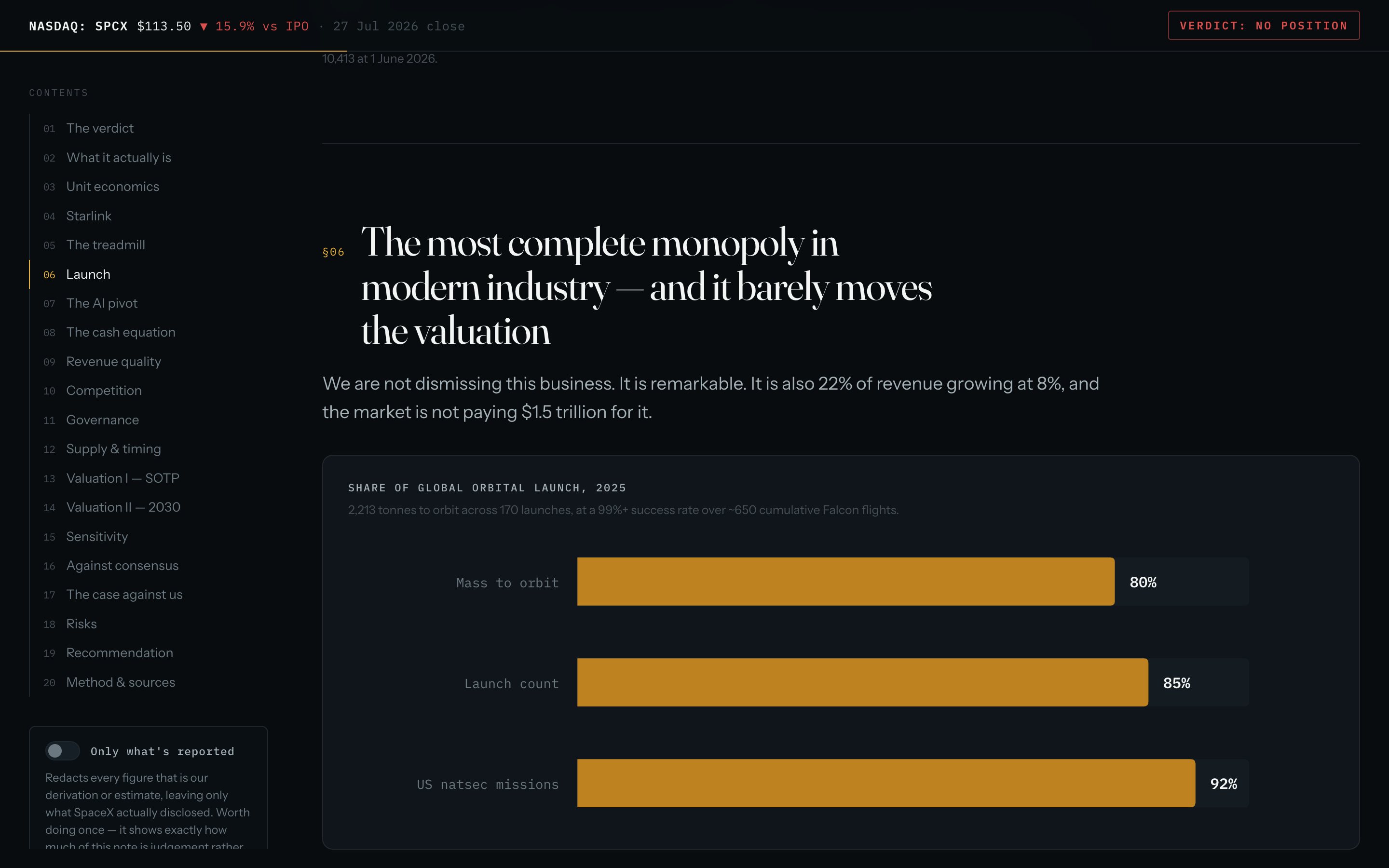
- Sixteen charts generated as SVG from a single embedded model, with nothing screenshotted and no chart library involved
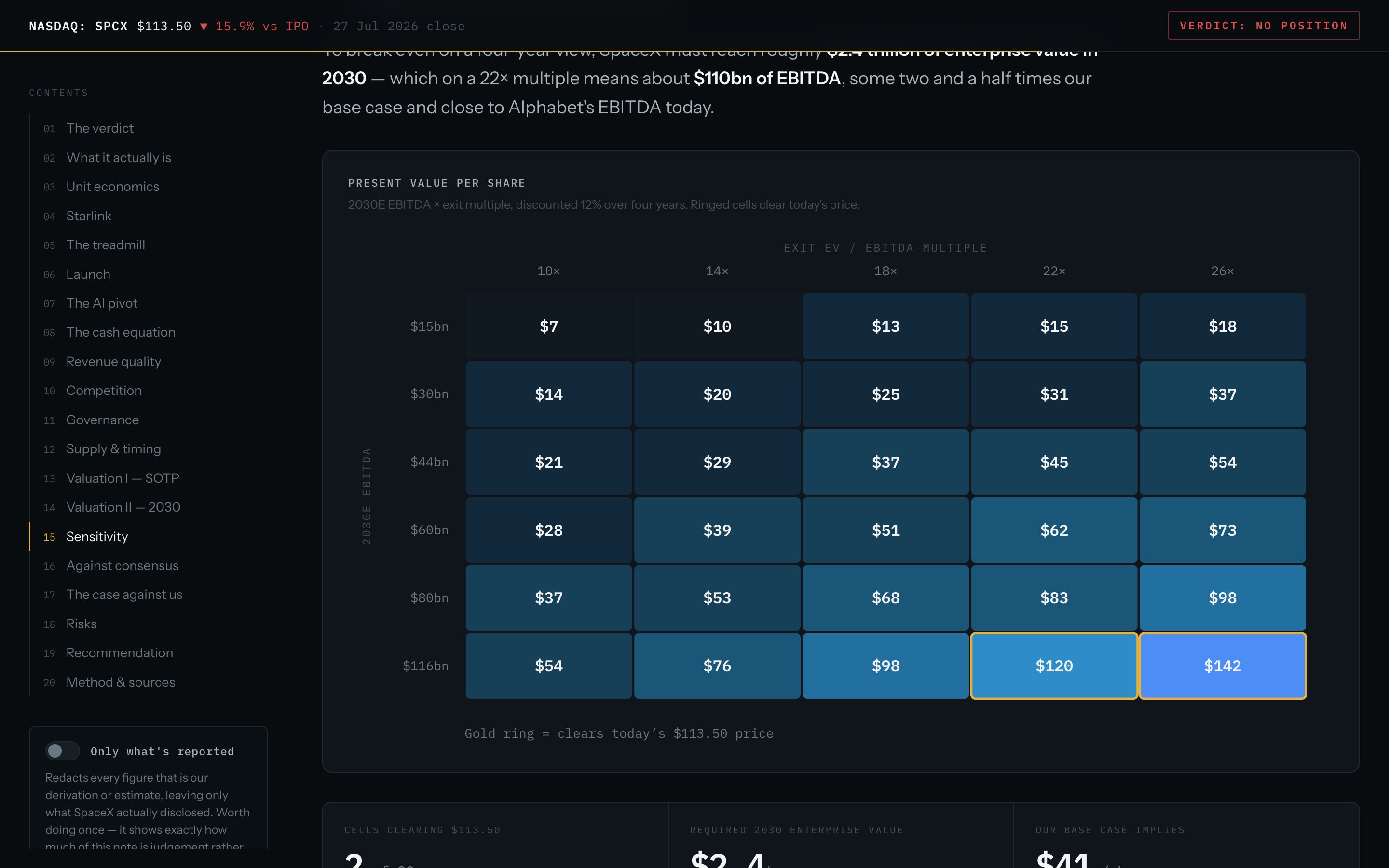
- A scenario switch driving two valuation sections at once, plus an exit-multiple slider that recomputes present value live
- A provenance redaction switch, so the same document can be shown to different audiences
Page sections overview
| Section | Purpose |
|---|---|
| Model-driven SVG charts | Generate every chart from one embedded model, with no imported images |
| Live scenario switching | Drive two valuation sections at once from one scenario control |
| Interactive sensitivity grid | Let the reader recompute present value with an exit-multiple slider |
| Provenance redaction switch | Hide or reveal sourcing so one document serves several audiences |
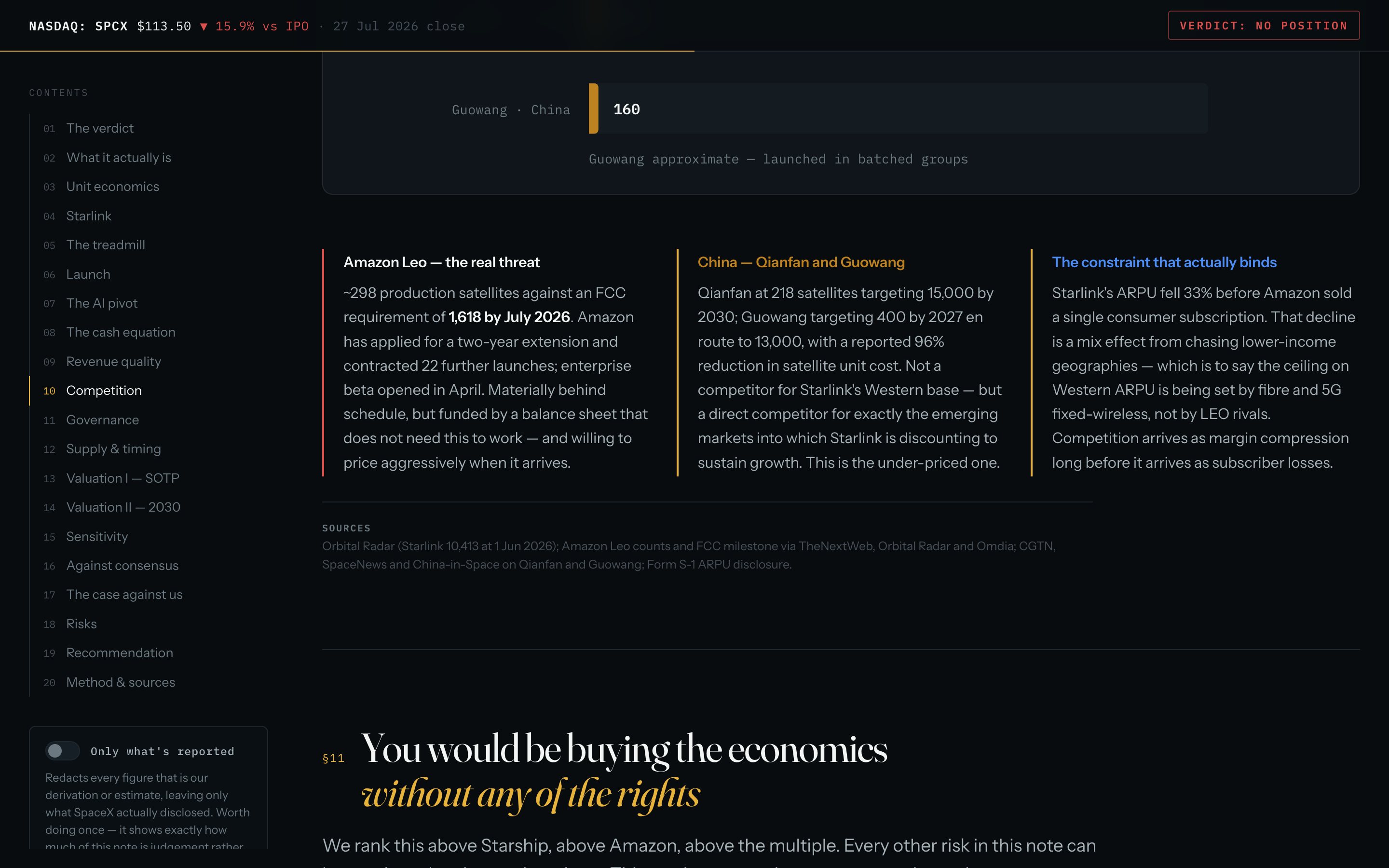
| Steel-manned counter-case | Devote a full section to the strongest argument against the thesis |
| Twenty-section structure | Build the recommendation from the segments up in numbered sections |
Design and branding system
The identity is a serious printed document brought to the web: ink on paper, hand-drawn chart marks, and typography built for sustained reading.
- A document-ink palette on warm paper, with chart colours chosen to stay distinguishable in greyscale when printed
- Hairline chart marks drawn by hand with no library, so every axis and gridline matches the document around it
- A long-form reading measure with tabular numerals in every table, tuned for reading all twenty sections in one sitting
Mobile and speed optimization
A research note is read on whatever screen is nearest, so the reading experience is tuned for both desk and phone.
- Line length, type scale, and table layouts adapt, so dense financial content stays legible on a phone
- The document is a single fast page, with no viewer to load, no download step, and no pinch-zooming
- Navigation and progress cues keep readers oriented through all twenty sections on any screen
How this template helps you convert
A published memo is proof of thinking. The page is structured so the depth itself does the persuading.
- The executive summary lands the thesis on the first screen, for readers who go no further
- Section structure lets a skimmer verify rigour in seconds: the table of contents is the sales pitch
- The full read rewards serious visitors, and serious visitors are the ones worth converting
Other information about this template
A few notes on this build.
- It’s a demonstration of research presentation. It isn’t investment advice or a recommendation on any security
- The whole document is one HTML file with no chart library and no build step
- Subject, palette, sections, and model are all rebuilt around your analysis. The machinery that makes it auditable carries over
- It reads well on a phone, which matters more for research documents than most publishers assume
How it works
Sixteen charts are generated as SVG from a single embedded model. Nothing is a screenshot and nothing comes from a chart library, so every mark is on-brand instead of styled around someone else’s defaults. A scenario switch drives two valuation sections at once, and an exit-multiple slider recomputes present value live, so a reader can test the argument rather than accept it. The signature is the provenance layer. Every hard number carries a tag for reported, derived, or estimated, and one switch in the contents rail redacts everything that is the author’s judgement. What’s left is only what the source documents disclosed. It answers the question a sceptical reader is already asking.
Where it fits
It fits anywhere a case has to survive scrutiny: a fund’s investment memo, a diligence summary, a market or category report, a consulting findings deck, or a data-journalism piece. The subject, palette, sections, and model all get rebuilt around your analysis. The machinery that makes it auditable carries over.
Screenshots
Captured from the live build, section by section, exactly as the template renders.